
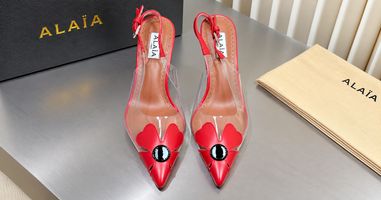
Alaïa Le Cœur Slingback Pumps: How Do They Look From Different Angles?
Alaïa Le Cœur slingback pumps do not present the same way from every viewpoint. Straight ahead, the pointed front and heart detail carry most of the attention. From the side, the open heel and slim strap become more important, while movement changes how these elements connect.
Walking, standing, turning, and sitting each reveal a different part of the construction. Looking at those shifts helps explain why the pair can feel sharper from one direction and lighter from another.
1. The Front View Concentrates Attention Near the Toe
Seen straight ahead, most of the visual information sits near the front.
The pointed toe creates a clear directional line, while the heart element interrupts that streamlined outline with a recognizable detail.
Because the rear construction is mostly hidden from this position, the shoe can initially appear closer to a conventional pointed pump than it does from the side.
That changes once the viewing angle moves away from the front.
2. A Three-Quarter View Shows More of the Construction
Turning slightly reveals details that disappear in a direct front view.
The toe still leads the silhouette, but part of the slingback opening becomes visible behind it. This creates a clearer relationship between the defined front and lighter rear.
A three-quarter angle also shows how the heart motif sits within the upper rather than appearing as an isolated ornament.
This is often where the shoe's front and rear features become easiest to read together.
3. Side Views Make the Open Heel More Important
From the side, the heart detail no longer dominates the entire impression.
The gap behind the foot becomes much more noticeable, and the strap forms a narrow connection around the rear. That gives Alaia Le Coeur shoes a lighter profile than the front view suggests.
The pointed toe still extends the line forward, but the exposed heel prevents the silhouette from feeling continuous or enclosed.
The result is a defined front paired with a more open back.
4. The Rear View Reduces the Presence of the Heart Detail
From behind, the main decorative element nearly disappears.
Attention shifts toward the heel, strap placement, and open space around the back of the foot.
This shows how little the design depends on repeating ornament around the entire shoe. The rear remains comparatively restrained.
As a result, the pair can look much quieter from behind than from the front.
5. Turning the Foot Changes the Balance
Small changes in foot position can alter which feature appears strongest.
A foot angled outward exposes more of the side and rear opening. Turned slightly inward, the pointed front and upper return to prominence.
This gives Alaïa Le Cœur pumps a more changeable silhouette than footwear where all major details sit on one flat surface.
Even a subtle shift in stance can change how much of the slingback construction remains visible.
6. Walking Creates a Front-to-Rear Sequence
Movement introduces a pattern that does not exist in a static pose.
As the foot moves forward, the pointed toe and front detail appear first. The side opening follows, then the strap and heel become easier to see as the leg passes.
Each step therefore reveals the design in stages.
That sequence gives the shoe more dimensional interest than a single static view can show.
7. Standing Still Makes Proportion Easier to Read
When the wearer is stationary, the relationship between each section becomes clearer.
The pointed front establishes length, while the open back reduces the amount of material visible around the foot.
A straight stance gives the most balanced reading of those proportions.
Shifting weight onto one leg can reveal slightly more of the strap and side opening, changing the profile without altering the overall stance.
8. A Lower Viewing Angle Changes the Emphasis
Viewing the shoe from a lower position changes which parts appear closest and most prominent.
The front surface, toe line, and heart detail can occupy more of the visual field, while the rear opening becomes easier to inspect because the eye is closer to the level of the shoe.
Seen this way, Alaïa Le Cœur shoes reveal more of the relationship between the upper, strap, and heel opening than they do from a typical standing eye level.
The pointed front may appear longer, while the open rear creates stronger separation around the heel.
This angle is useful because it changes the perceived proportions without relying on clothing length or movement.
9. Crossing the Legs Changes the Dominant Angle
Crossing one leg over the other turns the shoe away from a straight front presentation.
The side profile becomes more visible, particularly the strap and heel opening.
Depending on the direction of the crossed leg, the heart detail may remain fully visible or appear only in part.
The pointed toe still keeps the overall line defined even when the front no longer faces directly forward.
10. Distance Changes Which Detail Registers First
From farther away, the overall outline matters more than small decorative details.
The pointed toe and open rear are easier to notice before the heart motif becomes clear. As the viewer moves closer, Alaia slingback pumps reveal more of their front detail and surface finish.
At a distance, proportion carries the design; closer up, the heart element becomes the stronger identifying feature.
This allows the pair to remain distinctive at more than one viewing distance.
11. Lighting Can Shift Attention Between Surface and Shape
Light changes what becomes noticeable first.
Direct light can emphasize glossy surfaces and make the heart detail stand out more clearly. Softer lighting reduces reflection and places more emphasis on the silhouette.
Side lighting can define the open heel more strongly by increasing contrast around the gap behind the foot.
The same shoe can therefore appear more decorative or more structural depending on the lighting.
12. Photos and Real Movement Do Not Show the Same Shoe
A product photo usually captures one carefully selected angle.
Real wear is less fixed. The foot turns, the ankle bends, and the shoe appears differently from moment to moment.
A straight image may emphasize the heart motif, while movement gives the strap and heel opening much more presence.
Seeing the pair from several directions therefore gives a fuller picture than relying on one static view.
13. The Design Changes Without Losing Its Identity
The strongest feature of this pair is not that every angle looks the same.
From the front, the pointed toe and heart element lead. From the side, the open heel becomes more important. From behind, the shoe appears quieter.
That changeability gives Alaïa Le Cœur slingback shoes a more dimensional character than footwear defined by one flat decorative surface.
Movement shifts attention from one section to another, yet the key elements remain connected.
The pointed front, heart motif, slingback strap, and open heel continue to identify the pair even when their visual importance changes.
Clara Bennett
Clara Bennett writes about designer shoes, focusing on materials, proportions, styling, and the small design differences that change how a pair looks and wears. Her articles look closely at individual styles and how they fit into everyday, work, and occasion dressing.