
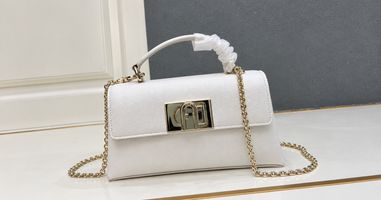
What Fits in a Furla 1927 Mini Bag?
Compact daily carry suits the furla 1927 mini bag best, especially with a slim wallet or cardholder, one main device, and a small selection of personal items. Its gusseted interior and separate pockets help organize a reduced load, but bulky cases and thick accessories can use the available depth quickly.
Capacity here is less about fitting a long checklist and more about deciding which objects need central space, which can stay flat, and which should be left out.
1. The Opening Sets the First Practical Boundary
Interior dimensions are only part of the capacity question. Objects also need to pass comfortably through the upper opening and settle into the compartment without forcing the sides outward.
A rigid item can appear small enough on paper yet feel awkward if it needs to be turned repeatedly before reaching the central space. Slimmer belongings are easier because they can enter at an angle and settle closer to the interior walls.
This makes access part of usable capacity rather than a separate concern.
2. The Gusseted Construction Creates a Usable Center
The sides open in a gusseted arrangement rather than forming one completely flat compartment.
That creates useful depth toward the middle, while slimmer belongings can sit closer to the interior walls. The bag therefore benefits from deliberate placement instead of tight packing.
Leaving some free space around the central objects can also make opening, closing and retrieving belongings easier.
3. Flat Items Preserve the Most Useful Space
Cards, a slim cardholder, folded papers or another thin case can rest against the interior walls without consuming much central depth.
Slim belongings preserve more usable depth, which keeps furla mini bag capacity manageable during regular use.
A thicker accessory changes the setup considerably. Even if its width fits comfortably, added depth can reduce the number of pieces that can sit beside it.
People already accustomed to compact accessories will usually organize this interior more easily than someone transferring the contents of a much larger handbag.
4. Device Placement Changes the Interior Layout
A phone usually becomes one of the largest flat objects in a mini bag, so its orientation affects what remains usable around it.
Placed upright or closer to one wall, it can leave the center more open for another item. Positioned across the compartment, it may divide the interior into smaller areas that are harder to use efficiently.
The better setup depends on the device and case rather than one fixed packing rule.
This is why capacity can feel different even when the same objects are being carried.
5. Separate Pockets Protect the Main Compartment
An open pocket and zipped pocket give smaller belongings dedicated places outside the central packing area.
Separate storage areas keep smaller pieces out of the center, so furla 1927 bag organization remains clearer while the main compartment stays available for larger items.
The rear exterior pocket can hold one slim item that benefits from faster access. Its value comes from convenience rather than substantial added capacity.
Good organization therefore reduces unnecessary stacking without pretending the mini format has more space than it does.
6. Accessory Format Matters More Than Category
Two wallets can take up very different amounts of space, just as two cosmetic cases or eyewear cases can.
For this interior, the useful distinction is whether an accessory is flat, flexible, or rigid. Flat pieces can follow the sides, flexible ones can adapt to small gaps, while rigid objects claim a fixed amount of room.
That makes accessory format a more useful capacity test than simply asking whether a wallet, case, or pouch belongs on the packing list.
7. Cosmetic Items Work Better in Smaller Forms
A large cosmetic pouch can consume too much of the central area.
Individual pieces such as a slim lip product or small mirror are easier to distribute around larger belongings. They can use spaces that would otherwise remain empty without forcing the bag to expand.
Leaving some unused room is useful. A tightly packed interior may technically close, but daily access becomes less convenient if several objects need to be removed each time.
8. Textured Leather Keeps the Exterior Controlled
The structured exterior is not designed to expand freely around everything placed inside it.
Textured leather and defined construction help the 1927 Mini retain its composed profile, so packing works better when the contents respect the existing form.
The same controlled exterior keeps furla leather mini bag proportions polished during regular use rather than only on occasional outings.
Compared with a softer pouch-style bag, this design places more emphasis on keeping its established proportions. A small amount of unused interior space can therefore be useful rather than wasted.
9. The Rear Pocket Works Best for One Flat Essential
The open pocket on the back is most useful for something slim and frequently needed.
It can separate one flat item from the main compartment and reduce how often the bag needs to be opened.
Its advantage is access, not major extra storage, so trying to fill the pocket heavily works against the compact construction.
10. Each Storage Area Works Better With a Clear Function
The interior becomes easier to manage when each section has a distinct purpose instead of every pocket competing for the same type of item.
The zipped pocket suits something small that should stay contained. The open interior pocket is better for a slim piece that may need quicker access, while the central compartment carries the larger essentials.
This division reduces overlap and keeps the main area from turning into an undifferentiated stack.
11. A Stable Daily Load Makes the Mini Easier to Use
Consistency matters more than variety when a compact bag becomes part of a regular routine.
A consistent set of belongings also makes organization inside the furla 1927 mini bag simpler and more predictable.
The open pocket can handle one type of slim item, the zipped section another, while the central area remains reserved for larger essentials.
Problems usually appear when the daily load keeps expanding. Extra cases, chargers, purchases or additional personal items can quickly use the small amount of spare room.
This format therefore suits someone who already knows what needs to come along better than someone who regularly carries extras just in case.
12. The Best Capacity Check Is Whether Space Still Remains Usable
A successful setup should leave more than enough room to close the bag.
After the essentials are inside, check whether the gusset can still open normally, the pockets remain reachable, and one item can be removed without disturbing several others.
That unused flexibility is important because a compact bag becomes frustrating when every object has only one exact position.
If the interior still works as a system rather than a tightly packed container, the capacity is likely suitable for regular use.
Clara Bennett
Clara Bennett writes about designer bags, focusing on materials, construction, proportions, capacity, and carrying options. Her articles look closely at how individual designs work in daily life, from interior organization and strap configurations to size, structure, and suitability for work, travel, and other occasions.