
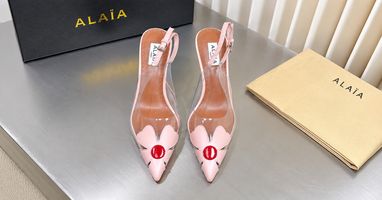
Alaïa Le Cœur Slingback Pumps: How Do Outfit Proportions Change Their Look?
Alaïa Le Cœur slingback pumps can look noticeably different depending on how much of the shoe remains visible, where a hem ends, and how closely the clothing frames the ankle. The pointed front and open rear stay the same, but their visual weight shifts as the surrounding proportions change.
That makes this pair especially responsive to trousers, skirts, dresses, and lower-body volume. Rather than treating the shoe as one fixed statement piece, it is more useful to look at how clothing frames the heart detail, toe line, strap, and heel opening.
1. Cropped Trousers Expose the Full Front
A cropped trouser leaves the pointed toe and heart-shaped front element almost fully visible, creating a stronger lower focal area than a longer hem would.
Straight cuts frame the shoe clearly because the trouser opening sits above it with little interruption. A wider crop introduces more fabric around the ankle, placing the front detail against a broader base.
The width of the opening also changes the space around the footwear. A compact cut keeps the toe closely connected to the trouser line, while a wider one creates more separation.
The same shoe can therefore appear sharper beneath a controlled crop or more expressive below a broader silhouette.
2. Ankle-Length Cuts Create a Tighter Frame
A hem ending close to the ankle leaves less empty space between clothing and footwear. This makes the shoe feel more integrated into the lower line.
The open rear remains visible from side angles, while the pointed front carries more attention from straight ahead. That tighter frame can make Alaïa Le Cœur shoes appear sharper without requiring a shorter cut.
Slim ankle openings emphasize the toe line; slightly wider openings soften the transition from fabric to footwear.
The difference comes from the frame around the shoe rather than a change in the shoe itself.
3. Longer Trousers Reduce the Decorative Impact
A full-length trouser can cover much of the upper and leave only the pointed front visible during movement.
This reduces the prominence of the heart element and shifts attention toward the toe. The shoe can read more like a refined pointed pump until the hem lifts enough to expose additional detail.
Walking creates brief changes in visibility, while sitting may reveal a larger section as the fabric rises above the ankle.
Wide-leg trousers increase this effect because the shoe appears and disappears beneath greater fabric volume.
This makes longer trousers useful when the decorative front should feel more restrained.
4. Narrow Skirts Keep the Lower Line Controlled
Straight and pencil-style skirts create a stable vertical outline, allowing the footwear to act as a clear finishing element rather than part of moving fabric.
Under this type of silhouette, Alaia Le Coeur pumps benefit from the contrast between a controlled skirt line and the more expressive heart detail.
A hem ending above the ankle leaves enough room for the pointed front and slingback strap to remain distinct.
Longer narrow skirts reduce how much of the rear construction remains visible and place greater emphasis on the toe.
5. Fuller Skirts Change the Rhythm
More fabric introduces movement around the lower body.
A fuller midi skirt can alternately expose and cover parts of the shoe, making the heart detail less constant while revealing the open heel from changing angles.
Volume matters as much as length. A lightly flared skirt leaves a clearer lower frame, while a fuller construction creates more interruption around the footwear.
The shoe becomes part of the movement rather than a fixed focal element, especially when the hem repeatedly crosses the front and rear sections.
6. The Best Proportion Depends on How Much of the Shoe You Want to Show
The most useful starting point is deciding whether the footwear should be immediately noticeable or appear more gradually.
Shorter or cleaner hems reveal more of the pointed front, strap, and open heel. Longer or fuller clothing reduces that exposure and lets the shoe appear in smaller sections.
For a clear view of the complete construction, Alaia Le Cœur slingback pumps work best when the ankle area is not heavily covered.
More coverage can still work when the heart detail should feel quieter, especially if the rest of the outfit already has a strong lower silhouette.
The choice is mainly about visibility and proportion.
7. Trouser Break Changes What Appears First
Two trousers can reach nearly the same length yet frame the shoe very differently depending on how the fabric meets the foot.
A clean break leaves the toe visible without adding extra folds near the front. This gives the pointed line a clearer ending and makes the heart element easier to read whenever it remains exposed.
More fabric gathering over the shoe creates a softer transition. The front decoration may appear only in sections, while the pointed toe becomes the most consistent visible feature.
A wider trouser can also fall differently on each step, sometimes covering one side of the shoe more than the other.
This makes trouser break a separate decision from overall length. Even small changes near the hem can determine whether the first impression comes from the toe, the motif, or the surrounding fabric.
8. Slits Reveal the Shoe in Narrow Sections
A skirt slit changes visibility without shortening the entire hem.
A front slit tends to reveal more of the pointed toe as the leg moves forward. A side slit can expose the strap and heel opening from a different angle, especially during walking.
Because the opening appears only through movement, the shoe is not continuously on display.
This creates a more selective view than a shorter skirt would. The heart element may appear briefly, then disappear again as the fabric closes.
A slit therefore allows a longer silhouette to retain coverage while still showing specific parts of the footwear.
9. Asymmetrical Hems Shift the Focal Area
An uneven hem does not frame both sides of the shoe in the same way.
One side may expose more ankle and rear strap, while the longer section partially covers the opposite side. That difference changes how the footwear is read from front, side, and three-quarter views.
The effect is particularly noticeable when Alaïa slingback pumps appear beneath a hem that rises on one side rather than ending at one consistent level.
Instead of presenting the whole shoe at once, the clothing directs attention toward selected areas.
That can make the pointed toe, heart detail, or open rear become dominant at different moments without changing the footwear itself.
10. Standing and Seated Views Are Not the Same
Hem position changes once the body moves from standing to sitting.
Full-length trousers usually rise at the ankle when seated, revealing more of the upper than they do while standing. A skirt can also shift upward or open differently around the leg.
This matters for a slingback because additional exposure does more than reveal the front. It may also bring the strap and heel opening into view.
An outfit that looks restrained while standing can therefore show much more of the shoe once seated.
This is useful to consider for dinners, meetings, or other settings where the wearer spends significant time sitting. The visible proportion is not fixed throughout the day.
11. The Shoe Works Best When the Surrounding Proportions Stay Deliberate
The strongest combinations usually have a clear decision behind how much of the footwear is exposed.
Longer trousers reduce the decorative impact. Cropped cuts reveal the pointed front. Skirts can expose the shoe through length, movement, slits, or an uneven hem rather than relying on one fixed opening.
The main question is which part should carry the attention. A cleaner ankle line gives the rear strap and heel opening more presence, while greater coverage shifts emphasis toward the pointed toe.
That flexibility is one reason Alaïa Le Cœur slingback shoes can move between restrained and more expressive outfits without changing their basic character.
The most effective proportion supports the intended focal area rather than revealing every feature at once.
Clothing length, width, openings, and movement ultimately decide which part becomes visible first.
Clara Bennett
Clara Bennett writes about designer shoes, focusing on materials, proportions, styling, and the small design differences that change how a pair looks and wears. Her articles look closely at individual styles and how they fit into everyday, work, and occasion dressing.