
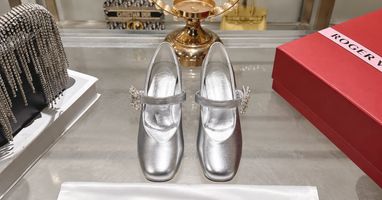
Roger Vivier Efflorescence Mary Janes: How Do Different Outfit Proportions Change Their Look?
Roger Vivier Mary Janes can look noticeably different depending on how much space clothing leaves around the foot. Trouser width, hem height, fabric weight, contrast, and ankle exposure can shift attention between the decorated front, cross strap, and open section above the upper.
Efflorescence brings several visual elements into a relatively compact area. Looking at the complete lower silhouette therefore tells more than judging the shoe separately from the clothing around it.
1. Begin With the Space Around the Foot
The footwear does not occupy the same apparent amount of space beneath every outfit.
A narrow trouser opening keeps fabric close to the upper and creates a compact frame. A skirt or wider trouser leaves more open area at the sides, changing how substantial the shoe appears.
That surrounding area matters even if the hem never touches the shoe. More open space can reduce the apparent scale of the footwear, while a tighter frame draws more attention toward its outer edges.
The effect becomes easier to notice once a strap and concentrated front ornament occupy the same upper. Each feature needs enough room to remain distinct rather than merging into one dense area near the foot.
2. Front Decoration Needs Its Own Area
Decoration near the toe becomes one of the first elements the eye notices. Its effect changes, however, according to what sits immediately above and beside it.
A plain hem leaves the front treatment easy to isolate. Pattern, embroidery, or heavy texture near the calf introduces another source of activity in the same part of the outfit.
This relationship matters for Roger Vivier Efflorescence Mary Janes, since much of their character is concentrated toward the front rather than distributed evenly from toe to heel.
That does not mean the clothing must remain plain. Richer elements can sit higher on the body, where they add interest without interrupting the front of the shoe.
A cleaner lower section usually creates the clearest distinction between footwear and garment.
3. Toe Exposure Changes the First Impression
The decorated front does not always need the whole upper to remain visible in order to register.
A lower trouser hem may leave only the toe and part of the vamp exposed. In that situation, the front ornament becomes the first—and sometimes the only—feature noticed.
A higher hem changes the order. Once the strap appears, the shoe reads less like a decorated pump and more clearly as a strapped design.
This distinction matters because Efflorescence carries more visual weight near the toe than many simpler styles.
Even a small change in front exposure can alter the first impression before the strap comes into view.
4. The Strap Can Disappear Before the Decoration Does
The front treatment sits lower on the shoe than the cross strap, so clothing can hide one feature while leaving the other almost untouched.
That creates a useful asymmetry.
A hem that rests just above the toe may preserve most of the ornament while removing the horizontal break created by the strap. Raise the hem slightly and the entire design reads differently because the upper construction becomes easier to recognize.
This is one reason the shoe can appear more ornamental under one outfit and more architectural under another.
The change comes from deciding which part of the original design remains visible.
5. Exposed Instep Changes the Lower Proportion
The area between strap and hem affects how connected the shoe feels to the leg above it.
More exposed skin creates a larger break. A shorter gap pulls garment and footwear closer together visually, especially if hosiery or fabric uses similar tones.
The cross strap already introduces a horizontal division, so Roger Vivier Mary Jane shoes respond noticeably to changes in the amount of open instep above that line.
A cropped trouser can emphasize the separation. Midi skirts leave even more uninterrupted space, while longer garments reduce it.
The effect can also vary by color. High contrast between skin, strap, and hem creates a sharper division; closer tones make the transition quieter.
6. Curved and Straight Hems Frame the Front Differently
Hem shape can change the way the decorated front sits beneath clothing even when garment length stays nearly the same.
A straight edge creates a firm horizontal boundary above the shoe. The front treatment then appears beneath a more controlled frame.
A curved or softly draped edge behaves differently. It creates uneven space around the foot, allowing one side of the upper to remain more exposed than the other.
That irregular framing can make the decoration feel less fixed and more connected to the movement of the garment.
This becomes particularly noticeable when a concentrated front accent is surrounded by changing amounts of open space.
7. Rich Texture Can Stay Elsewhere in the Outfit
Decorative footwear does not require every surrounding surface to be smooth.
A substantial knit, textured jacket, wool coat, or satin top can introduce depth higher up while the lower part remains more controlled.
This vertical separation matters because several rich surfaces crowded around the ankle can reduce the distinction between fabric and footwear.
Keeping stronger texture farther from the toe allows Roger Vivier Efflorescence shoes to retain a clearer area of their own.
A simple skirt beneath a textured jacket is one route. Clean trousers paired with a more expressive top provide another.
The objective is not restraint everywhere. It is to distribute visual interest instead of concentrating it all close to the ground.
8. Surface Finish Changes How the Ornament Separates From the Shoe
Color is only one part of the contrast around a decorated front.
A matte fabric near the foot absorbs more light and can make reflective ornament stand out more strongly. A shinier garment introduces additional highlights, reducing the difference between clothing and shoe.
Texture can alter that boundary again.
Dense wool creates a soft, low-reflection surface. Satin or coated fabric produces a cleaner shine that may sit closer to the visual quality of the front treatment.
The result depends on how much separation exists between those surfaces, not simply whether the colors are light or dark.
That makes finish an important styling variable when the decoration itself reacts strongly to light.
9. Ankle Coverage Can Soften the Strap
The strap creates a clear horizontal line, but its strength depends on what appears immediately above it.
Bare skin leaves that division easy to see. Sheer hosiery softens the transition slightly while preserving most of the contrast.
Opaque tights can connect the leg and footwear more closely, particularly when their tones are similar. The strap remains present, but it no longer interrupts the lower silhouette as sharply.
That can be useful if the front treatment is already carrying enough visual emphasis.
The same footwear can therefore shift from highly segmented to more continuous without changing the skirt or trouser silhouette itself.
10. Keep the Front and Strap Readable Together
The decorated front and cross strap perform different visual functions.
The toe area pulls attention forward, while the strap establishes the recognizable construction farther back on the upper.
A low trouser hem can reduce that relationship by hiding the strap and leaving mostly the decorated front exposed. A more open hem lets both elements register in the same view.
For people considering Roger Vivier Mary Janes, the full product view is available here: https://www.bniox.com/products/roger-vivier-efflorescence-mary-janes-shoes-robh09
The useful question is not whether the entire shoe must remain exposed. It is whether enough of both areas can be seen for the original design balance to stay intact.
Movement may alter that balance temporarily, but the relationship between front and strap remains more important than maximum exposure.
11. Slits and Openings Can Reveal the Shoe Unevenly
A dress or skirt does not always expose the shoe symmetrically.
A side slit, front opening, or wrap construction can reveal one side of the foot more frequently than the other. That changes which part of the upper becomes easiest to notice during movement.
A centered opening may direct more attention toward the decorated front. A side opening can expose the strap and side profile more clearly as the wearer walks.
This creates a different effect from simply shortening the hem.
Instead of increasing exposure everywhere, the garment selectively reveals specific parts of the shoe.
That selective view can keep the footwear noticeable without presenting its full structure continuously.
12. Nearby Edges Can Echo the Cross Strap
The cross strap introduces a deliberate horizontal break across the foot.
A sharply cut trouser hem or firm skirt edge can repeat that direction higher up, creating a stronger connection between garment and shoe.
The result feels more graphic because the eye encounters several firm horizontal boundaries within a small vertical area.
Curved hems, angled openings, and softer draping interrupt that repetition. The strap then feels more independent from the clothing above it.
This distinction matters most when the front decoration already carries plenty of visual activity. A repeated straight edge can reinforce structure, while a softer hem keeps the emphasis closer to the ornament.
Two garments of similar length can therefore frame the same shoe very differently simply because their lower edges behave in different ways.
13. Let One Feature Lead
The shoe does not need every recognizable element to carry equal emphasis at the same time.
A compact trouser opening can make the upper feel more contained, while a wider or softer hem may allow the decorated front to appear first and the strap later.
That flexibility lets Roger Vivier Mary Janes shift emphasis without losing their underlying construction.
If the front ornament should lead, clothing can leave less of the upper exposed while preserving the toe area. If the strap deserves equal attention, more open space above the shoe keeps both sections easy to read.
Texture and color can then support that choice instead of competing with it.
The most useful result comes from setting a visual priority first, then letting the surrounding proportions support it.
Clara Bennett
Clara Bennett writes about designer shoes, focusing on materials, proportions, styling, and the small design differences that change how a pair looks and wears. Her articles look closely at individual styles and how they fit into everyday, work, and occasion dressing.