
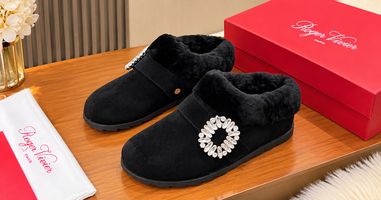
Roger Vivier Shoes: How Slidy Viv' Mules Fit Everyday Dressing
Roger Vivier Slidy Viv' works best when someone wants an easy slip-on shoe that still brings enough detail to finish denim, trousers, knitwear, or a simple skirt. The open heel keeps the profile relaxed, while the stronger front prevents it from reading like a basic house mule.
That combination is the reason to consider the style. It sits between a structured loafer and a very casual slip-on, so the most useful question is not whether it is formal or casual. It is whether that middle ground fills a real gap in the wardrobe.
1. The Open Heel Changes the Starting Point
A closed loafer surrounds the foot from toe to heel. Slidy Viv' begins from a different idea: most of the structure stays forward, while the back remains open.
You notice that immediately when slipping it on. There is less ceremony than fastening a shoe or easing into a stiff heel counter, yet the front still looks substantial enough to register as part of the outfit.
This matters on days built around short walks, sitting, driving, errands, or moving between indoors and outdoors. The shoe does not need to behave like a sneaker to be useful; it simply serves a different kind of day.
2. Most of the Presence Sits at the Front
Remove structure from the heel and the eye naturally spends more time near the toe.
That puts more responsibility on the vamp, buckle, material, and toe outline. If the trousers stop high enough to reveal the whole upper, those elements read together. If fabric drops lower, the front may be almost all that remains visible.
This front-weighted look is part of the appeal. The shoe can add something noticeable to an otherwise quiet outfit without carrying the bulk of a fully enclosed loafer.
A straight dark trouser is a good example. Nothing complicated is happening, yet the stronger front prevents the lower half from feeling unfinished.
3. It Fills a Different Role From a Formal Flat
A useful shoe rotation works better when each pair has a reason to be there.
Some pairs suit polished tailoring or occasions where a closed silhouette feels right. Within Roger Vivier shoes, a backless style answers a different need: more ease, less enclosure, but still enough presence to look deliberate.
That is where Slidy Viv' earns its place. It does not need to compete directly with pumps or classic loafers.
If structured flats already cover the formal side of the wardrobe, a more relaxed slip-on may add more range than another similar closed design.
4. The Rear Opening Prevents the Shoe From Feeling Too Dense
The front carries noticeable visual weight, yet the side profile never becomes fully solid because the heel is exposed.
That contrast is easy to see under ankle-length trousers. The upper feels substantial from the front, then the silhouette opens as the eye moves backward.
A midi skirt shows the same idea more clearly. There is enough space around the ankle for the rear opening to become part of the look rather than disappear under fabric.
Heavier wool trousers or a substantial knit can still sit comfortably above the shoe. The exposed heel keeps a small break in the lower silhouette instead of letting everything collect into one dense block.
5. Quiet Clothing Lets the Shoe Finish the Outfit
An outfit of straight denim, a soft crewneck, and a compact jacket does not need another large statement piece.
In that setting, Roger Vivier Slidy Viv shoes can take over the finishing role. The front carries enough character to give simple clothes a clearer endpoint, yet the back keeps the result from turning dressy.
The same logic works for trousers and a fine knit. Instead of adding pattern, jewelry, or a more elaborate bag, the shoe can provide the one stronger detail near the floor.
That is useful for repeat wear. The surrounding pieces can change substantially while the footwear keeps doing the same job.
6. Slip-On Wear Has Its Own Rhythm
Open-backed footwear feels different once the day involves more than standing in front of a mirror.
The heel moves freely, the front section keeps the foot aligned, and the shoe feels less contained than a conventional loafer. Some people enjoy that immediately; others prefer more rear support when walking for longer stretches.
That is why how the slip-on construction works for longer wear deserves its own discussion rather than being reduced to “easy to put on.”
Think about the actual day: walking several blocks, sitting for hours, stepping in and out of a car, moving around an office, or spending most of the time indoors. A mule can feel perfectly suited to one of those routines and less ideal for another.
7. A Mule Does Not Have to Look Casual Everywhere
Backless shoes naturally lean relaxed, but the rest of the design can pull them in another direction.
A pressed trouser crease creates one kind of contrast, while a fluid midi skirt creates another. In both cases, the open rear adds ease while the upper keeps the shoe visually finished.
That balance is especially clear when Roger Vivier Slidy Viv' mules sit beneath clothing that mixes clean structure with softer fabric or movement.
The strongest outfits usually contain both qualities. Too many casual pieces can make the shoe disappear into the background, while a completely formal outfit may fight its slip-on construction.
A small amount of tension is useful here.
8. Decoration Needs Breathing Room Near the Foot
A noticeable upper does not mean every other garment must be plain.
The key is location.
A textured knit near the shoulders, a substantial coat, or a patterned bag carried higher on the body can coexist easily because those details are separated from the shoe.
Problems start when several strong elements gather within the same narrow zone. Embellished trouser hems, dense hosiery, busy pattern, and a decorated shoe all asking for attention near the ankle can make the lower section harder to read.
A calmer few inches around the foot are usually enough. The rest of the outfit can still carry texture, pattern, or stronger accessories elsewhere.
9. Ease Should Look Intentional
The relaxed quality built into the open heel works better when the rest of the outfit acknowledges it rather than trying to disguise it.
Soft tailoring is an easy route. The lines remain clean, but the fabric does not feel rigid.
Dark denim and fine knitwear work for the same reason. They give Roger Vivier Slidy Viv' enough structure nearby without pretending the shoe belongs to a highly formal uniform.
Even a sharper jacket can fit if something lower in the outfit is less strict—a softer trouser, an open neckline, or a skirt that moves easily.
The shoe feels most natural when the outfit has one or two relaxed decisions built in from the start.
10. Suede Changes the Relationship to the Wardrobe
Material matters more on a mule because so much surface area is concentrated at the front.
Suede reads softer than polished leather and tends to sit comfortably beside wool, denim, brushed knits, corduroy, or other matte materials.
That creates a different mood from pairing the same silhouette with sleek, reflective fabrics. Instead of standing apart sharply, the shoe can blend into a richer field of texture.
This is where how suede changes the pair across different outfits becomes useful. Fabric weight, season, and surface finish can move the same general silhouette toward very different wardrobes.
The result depends less on a single “best” combination than on how many textures the outfit asks the eye to process at once.
11. Polished Clothing Can Benefit From a Less Formal Shoe
A tailored trouser and structured jacket can sometimes feel overly precise when every other element follows the same direction.
A slip-on changes that equation.
Instead of matching tailoring exactly, a more relaxed pair from the wider Roger Vivier shoes range can soften the outfit and create a less formal ending.
A crisp shirt, straight trouser, and mule create a different balance from the same outfit finished by a closed loafer. Neither is automatically better; they simply send different signals.
For wardrobes heavy on structured clothes, that softer ending can be more useful than adding another equally formal option.
12. Trouser Width Changes the Amount You See at Once
A narrow trouser opening leaves the front easy to read and tends to reveal more of the open rear from the side.
A wider leg breaks the view into moments. One step shows the toe, another reveals more of the upper, and the heel may appear only briefly as the fabric moves.
That changing frame can work in the shoe's favor. The front detail feels less constant beneath a wider trouser, so the overall effect becomes quieter.
Length matters too, but width often changes the experience more than expected. Two trousers can finish at almost the same point and still show very different amounts of the shoe once the wearer starts moving.
13. Toe and Sole Decide How Casual the Profile Feels
The front outline and sole establish much of the shoe's character before anyone notices smaller decoration.
A rounded toe softens the profile. A more substantial sole adds weight underneath and keeps the shoe from feeling delicate.
Those elements give Roger Vivier Slidy Viv shoes a grounded base beneath the more polished treatment above.
That contrast explains why the pair can sit beside denim without looking overdressed, then move under cleaner tailoring without looking purely casual.
For a closer look, how the round toe and sole change the profile is the useful next step. Those structural details say more about wardrobe fit than ornament by itself.
14. Skirts Show More of the Open-Back Character
A trouser creates a frame around the foot. A skirt removes most of that frame.
The result is a clearer view of the heel opening and the amount of skin above it.
A straight midi skirt keeps the lower section controlled. A fuller skirt introduces movement and can make the shoe feel smaller beneath the fabric.
Longer skirts can work too, particularly when walking reveals enough of the upper for the shoe to remain recognizable.
The one combination to watch is a heavy hem that hides nearly everything except the decorated toe. Once that happens, much of what separates this style from another embellished flat disappears.
15. The Product Works Best When the Front Has a Job to Do
Some wardrobes already have plenty of quiet flats. In that case, another nearly invisible shoe adds little.
For someone who wants the front of the shoe to contribute something noticeable while keeping the overall construction easy, Roger Vivier Slidy Viv' mules make more sense.
Think of plain denim, clean trousers, a knit dress, or a simple midi skirt. None requires elaborate footwear, but each can benefit from a more defined finish near the ground.
The open back keeps the shoe from becoming overly polished, which is what gives it room to move across those different combinations.
Its value comes from that specific pairing: detail in front, ease behind.
16. The Best Test Is Whether It Solves a Repeating Problem
Versatility sounds attractive, but it can become too vague to help with an actual wardrobe decision.
Maybe a casual flat feels too plain under certain trousers. Maybe a closed loafer looks heavier or more formal than the outfit needs. Maybe a skirt needs something more finished than a minimal slip-on but less rigid than a pump.
Those are the situations worth noticing before buying.
If they happen often, Slidy Viv' already has a job waiting for it. If they rarely come up, the design may still be appealing, but repeat wear becomes harder to predict.
Clara Bennett
Clara Bennett writes about designer shoes, focusing on materials, proportions, styling, and the small design differences that change how a pair looks and wears. Her articles look closely at individual styles and how they fit into everyday, work, and occasion dressing.